


You know that feeling. You eat a few slices of fresh pineapple, and within minutes your tongue starts to tingle, your lips feel raw, and the corners of your mouth go a little numb. Eat enough of it, and you'll start to wonder if you're allergic. If you don't have a true pineapple allergy, you're not. What's happening is that the pineapple is, in a small but very real way, digesting you.
The enzyme responsible is called bromelain, and it's one of nature's more interesting molecules. Named for the botanical family Bromeliaceae, to which pineapples belong, bromelain is not a single enzyme, but a mixture of proteolytic enzymes (the protein-digesting kind). It cleaves the bonds between amino acids in protein molecules, breaking them apart. Your tongue and the lining of your mouth are made of protein. The tingle is bromelain working on you briefly, before saliva dilutes it and you swallow.
For most people, this is a curiosity. For your digestive system, it's a hint at something far more useful.
Understanding the enzyme and how it works
When I first began practice, I became very close to an elderly Swedish gentleman who was a retired building inspector for the town of Greenwich, CT. Even though of advanced age, he would still be called in on difficult cases, and in one instance, fell off a scaffold onto a concrete floor. A bit of a contrarian by nature, he reportedly told those around him, 'Get my naturopath.'
Looking at him, I was reminded of the cartoon Beetle Bailey, after the Sarge was done with him. I got him into a chair and suggested bromelain support. Based on my clinical experience, timing matters enormously with this enzyme. He continued taking this over the next few days.
The key with bromelain is to take it at the very first opportunity after physical stress. That's when it appears most useful in supporting the body's normal recovery processes. With the passage of time, the body's response shifts, and bromelain may be less effective.
(Please note: Falls and physical injuries should always be evaluated promptly by a qualified healthcare professional. The above reflects one clinician's experience and is shared for educational purposes only. Individual results will vary.)
Two bromelains, not one
Here's the wrinkle that matters for anyone thinking about bromelain as a supplement: the bromelain in fresh pineapple is not equivalent to the bromelain you find at the pharmacy. There are two distinct forms of the enzyme: fruit bromelain and stem bromelain. They differ in concentration, composition, and clinical activity.
Nearly all commercial bromelain comes from the stem and core of the plant, not the fruit. The stem contains far higher concentrations of the relevant enzymes, and it's also the part of the pineapple that gets discarded during fruit processing, making it cheap and abundant raw material for supplement manufacturers. Stem bromelain has been the subject of nearly all the meaningful clinical research on this enzyme, and it's what's referenced in studies on its effects on normal inflammatory response, normal recovery processes, and digestive support.
This means eating pineapple, while it does deliver some bromelain to your system, doesn't replicate what a therapeutic dose looks like. A typical bromelain capsule might contain 500 mg of stem bromelain with an enzyme activity of 2,400 GDU per gram. To approach that with fruit alone, you'd need to eat several large pineapples, and much of the activity would be neutralized by stomach acid and offset by the sheer sugar load involved.
Pineapple is still a delicious source, and the tingle is real evidence of the enzyme at work, but it's a glimpse of what bromelain can do, not a delivery vehicle for a meaningful dose.
What bromelain does in the body
Two distinct uses, with two different ways of taking it:
-
- For digestion, bromelain helps break down dietary proteins. People with insufficient pancreatic enzyme output, which becomes more common with age and certain conditions, often find that supplementing with bromelain at meals supports normal digestive comfort, including occasional post-meal bloating and gas. The enzyme remains active across a surprisingly wide pH range, including parts of the stomach and small intestine. That's unusual among plant-derived enzymes, most of which are denatured by stomach acid.
-
- For supporting a healthy inflammatory response, the picture is different. Taken between meals on an empty stomach, bromelain is absorbed intact into the bloodstream. Yes, an enzyme actually crosses the intestinal barrier in active form — it's one of the few that does. Once circulating, it is understood to interact with several pathways involved in the body's normal inflammatory response and recovery processes. These are areas of ongoing research interest.
The research base is meaningful, though uneven. Bromelain has been studied in a range of clinical contexts related to normal recovery and inflammatory processes, including post-procedure care, sinus comfort, joint health support, and sports recovery.
Separately, a specific bromelain-based pharmaceutical formulation called NexoBrid has received FDA approval as a prescription debridement agent for severe burns, which is worth noting purely as evidence of the widespread scientific interest in this enzyme; however, that approval applies strictly to a drug product and not to dietary supplements such as ours which are intended only for health support.
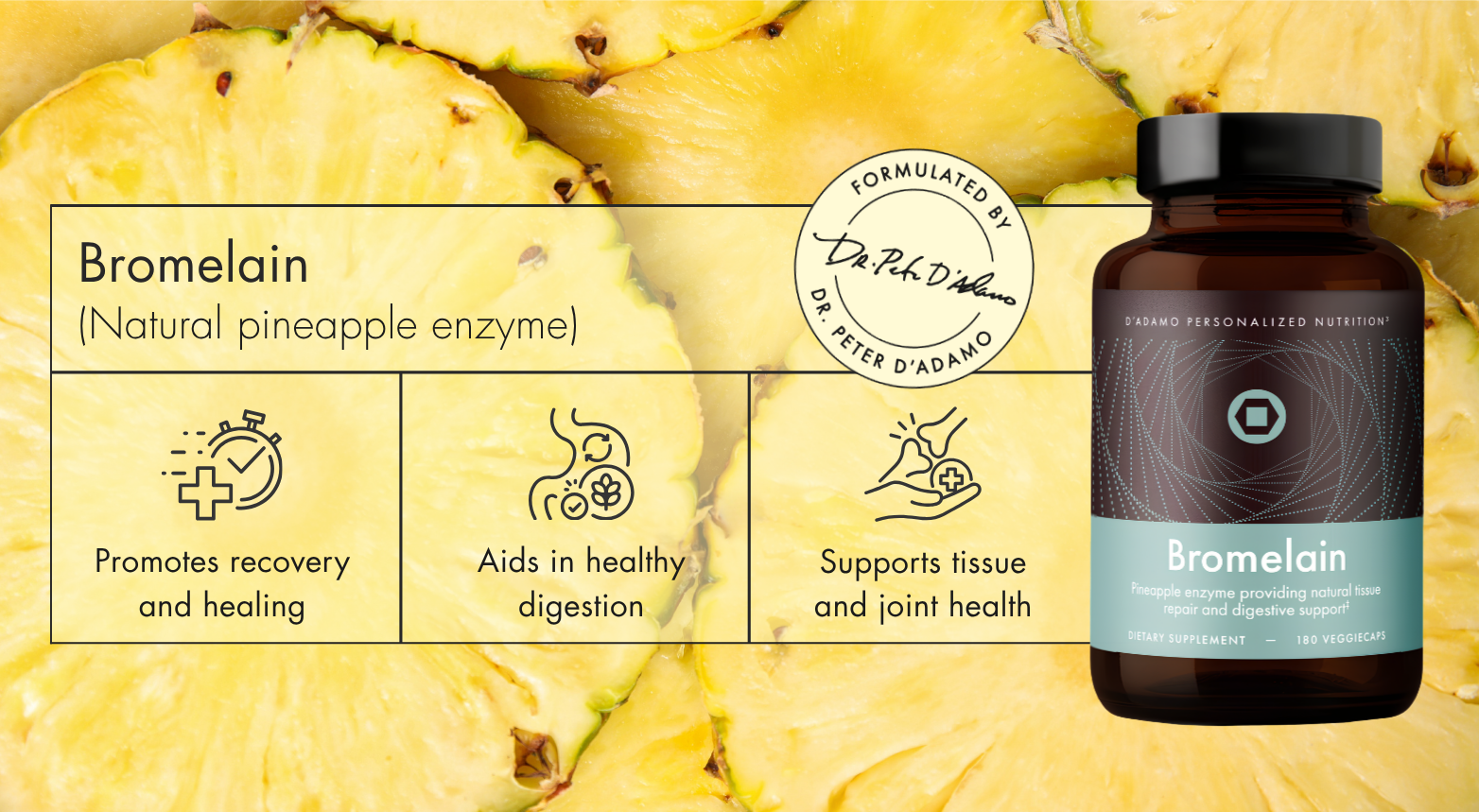
Shop Bromelain →
If you're considering bromelain as a supplement, a few principles are worth knowing:
-
- Take it with meals for digestive support; take between meals on an empty stomach to support normal inflammatory processes.
- Check whether the product specifies activity units (GDU or MCU), not just milligrams. A 500 mg capsule of low-activity bromelain may do less than 200 mg of high-activity (our Bromelain is the highest strength and purity, to help ensure maximum enzymatic activity).
- Be aware that bromelain has mild effects on platelet activity. If you take blood thinners, are scheduled for surgery, or have a bleeding disorder, talk to a physician before adding it. Most people tolerate it well, but allergic reactions are possible, especially in those with sensitivities to other tropical fruits or to latex.
And yes, keep eating fresh pineapple. The tingle isn't a problem to solve. It's just the enzyme reminding you it's there.
