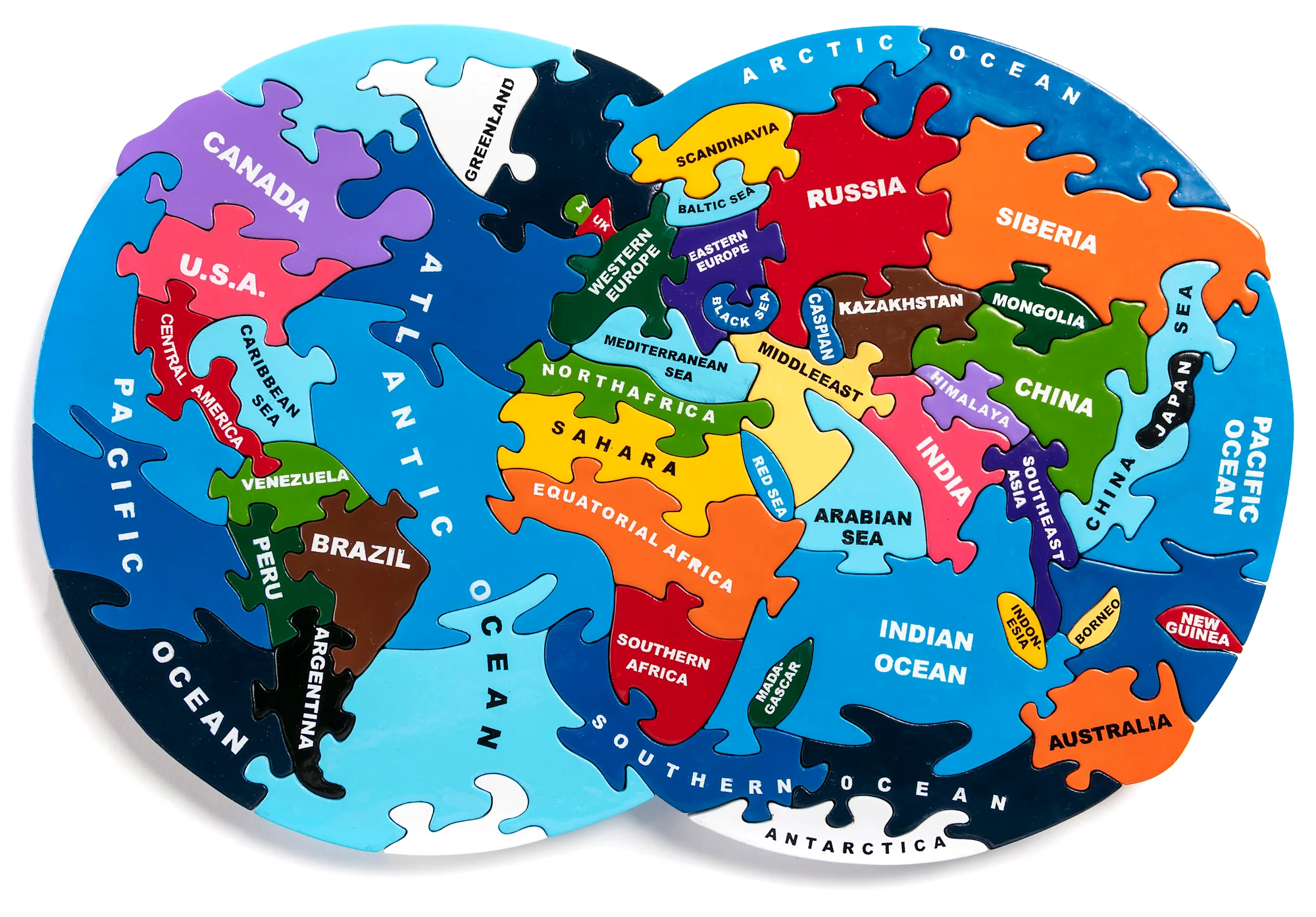
Imagine you have spent your whole life in France. You think in French, you argue in French, you take your coffee standing at the counter and your lunch seriously. None of this is written down anywhere. It is simply the tuning you acquired by growing up in one particular place, a thousand small settings adjusted to one particular world.
Now the world lurches, and a wheel is spun. It will send you, permanently, to one of three countries: Finland, Belgium, or China. You do not get to choose. The question is only this: in which of the three would you be most at home, and in which least?
Belgium, surely, would be gentlest. A shared language on one side of the country, a shared table, a shared sense of how a day is shaped. Much of your tuning would still work. Finland would be harder. The language is unrelated, the sociability cooler and more spacious, the winters a different order of dark, though the underlying European rhythms would still rhyme here and there. China would be hardest of all: the furthest from what you are set up for. Almost every default you carry would need re-examining.
You did not become a bad fit for China by being defective. You became a bad fit by being tuned, carefully and over a lifetime, to somewhere else. Your fitness was never a fixed property of you. It was always a relationship between your settings and your setting. Move the setting, and the same person becomes an easy fit or an awkward one without changing at all.
Blood type works exactly like this. It is a set of biological habits tuned to one world, and its worth depends on which world you are dropped into.
The tuning As we’ve seen, ABO blood type is set by a single gene that encodes an enzyme, a molecular tool that carries out one chemical reaction. Its job is to attach a specific sugar to a structure already sitting on the surface of your cells. Attach one sugar, and you are type A; attach a slightly different one, and you are B; attach both and you are AB; inherit a broken copy of the gene that attaches nothing, and you are O. The A and B distinction is older than our species by tens of millions of years. It appears across other primates in a pattern showing it predates the species that carry it, a situation biologists call a trans-species polymorphism, a genetic difference so ancient it was inherited intact from a shared ancestor rather than arising fresh in each descendant. You did not develop your blood type: You inherited a very old dial with settings already in use before there were humans to use them.
Why have these settings survived so long, side by side, instead of one of them winning out?
Aimless drift, the slow random wandering of gene frequencies over generations, wears variation away; it does not preserve it across tens of millions of years. Survival on that timescale is the signature of balancing selection, a form of natural selection that actively keeps several versions of a gene in circulation rather than letting one take over. The force doing the balancing here is disease.
Your body makes antibodies, immune proteins that latch onto foreign material, against whichever blood-group sugars you do not carry yourself. A population that contains every type presents no single target, so no one pathogen, no disease-causing microbe, can dress itself to slip past everybody. When an epidemic hits one type hardest, the survivors skew toward the others, and the balance shifts, until the next threat shifts it back. There is no best type. There is only the type that fits the moment, and the moment is always changing.
This is the ‘France’ of the story. A blood type is a lifetime of tuning to a particular world of environments, foods and microbes. And, exactly as in the parable, its value was never fixed.
The wheel is spun For nearly all of human history, the setting changed slowly, if at all. The microbes shifted, the balance drifted, but the pace was one a genome could keep up with.
Then, very recently, the wheel was spun hard.
Industrialized humanity dropped itself into a country it had never lived in before: a place of reliable, year-round food, rich in calories, fat, and protein, arriving faster and in greater abundance than any ancestral population ever knew. The question the parable asks returns in a new form. Given this new country, whose tuning is the better fit, and whose is the worse?
One of the settings that may matter runs through a gut enzyme called intestinal alkaline phosphatase, or IAP, a protein anchored to the lining of the small intestine that clips phosphate groups off molecules passing by.
One of those molecules is the reason it matters here. Your gut holds trillions of bacteria, mostly harmless, but a great many of them wear an outer coat built from lipopolysaccharide, usually shortened to LPS and also called endotoxin, which is among the most powerful inflammatory triggers your immune system knows. Let loose in the bloodstream, even a tiny amount of endotoxin reads to the body as an alarm. IAP defuses it, snipping the phosphate groups off the active part of the molecule so it can no longer sound that alarm.
This matters because a high-fat diet increases the leakage of endotoxin out of the gut and into the blood, a chronic low-grade condition called metabolic endotoxemia, endotoxin circulating at levels too low to make you acutely sick but high enough to keep the immune system permanently simmering. That simmer is the slow inflammation that underlies much of modern metabolic disease. IAP, in short, is a setting that disarms precisely the insult the new country serves at every meal.
In animals, take IAP away or turn it down and high-fat-diet outcomes get worse: more endotoxin crossing into the blood, more inflammation, more metabolic damage. Give the enzyme back by mouth and much of that reverses. So the idea that more IAP specifically softens the inflammatory load of a fatty diet is one of the better-understood things the enzyme does.
Now the tuning connects to blood type. Group O individuals and secretors carry markedly higher IAP than group A. If that difference reflects genuinely more enzyme at work at the gut wall, then here is the parable's payoff in biological form. The blood-type tuning that raises IAP is a better fit for the new country, the modern high-fat table, than it was for the old one, because the thing it defends against, metabolic endotoxemia, is largely a hazard of modern abundance. Group O, on this reading, is France dropped into Belgium. Group A is France dropped someplace harder.
A blood type was not ‘designed’ for any diet. It is a claim about mismatch, about what happens when a setting made for one world is carried into another. The relative advantage of one type over another, what biologists would call the fitness differential, shifts when the environment changes, without the gene itself changing at all. The old variation is simply re-weighted by new conditions.
Set beside the long-known link between group A and cardiovascular disease, the diseases of the heart and vessels, this suggests a second contributor sitting next to the familiar one. The familiar explanation runs through clotting: group A carries higher levels of certain clotting proteins, which raises cardiovascular risk. The proposal here adds a gut-level route, lower IAP in group A letting more inflammatory and fatty material through the gut wall under a diet that oversupplies both. It does not evict the clotting story. It pulls up a chair beside it.
This is the maturity you would expect of a mechanism well characterized in animals and plausible in humans that has not yet had a dedicated human trial. It is also worth being frank about why the trial has not happened. Testing it would mean feeding controlled diets to people grouped by blood type and tracking gut-surface enzyme activity and inflammation over years, which is slow, costly, and yields no patent and no product at the end. There is no money in proving that an unpatentable enzyme, handed out for free by an accident of blood type, quietly cushions the cost of eating richly.
Good fits and bad ones Return to the wheel one last time. You were never a good or a bad person for China or Belgium or Finland. You were a set of habits tuned to France, and the wheel decided whether that tuning would serve you or fight you. Nothing about you changed. The world you were dropped into did.
We are not designs, but rather verdicts. A great fit for some worlds and a less desirable one for others. You did not inherit the best type, because there is no best type, any more than there is a best nationality to carry into an unknown country. You inherited one set of very old settings, kept in play across tens of millions of years because a species full of different settings is harder for any single disease to defeat. Those settings were tuned by a world of illnesses and microbes. But the world spun its wheel, and set you down at a table your ancestors never sat at, and now the old tuning fits that table well, or badly, or somewhere in between.