
|
Dr. D'Adamo's Newsletter
|
| Moving
in March |
Martha D'Adamo
|
| Stress is at epidemic proportions in our society, and we all are facing challenges in our lives as we raise our families, go to school, build our careers, care for sick friends/families, stay financially solid in these troubled economic times, and take care of ourselves. Taking care of ourselves should be at the top of the list, but oftentimes it reverts to the end because of the demands of our lives. |
|
For the first time in three years, I have gotten hit with the flu. First of all, I am not used to being sick, so it is a surprising experience and one that I do not want to grow accustomed to. Secondly, I was trying to figure out what “set me up” for this. I eat well, I take good care of myself, and aha! I am off my regular exercise routine due to my increased workload the last six month.
As an O, I need vigorous exercise. For the past ten years, I have trained in Tang Soo Do, a Korean martial art. It is physically demanding, cardio-pumping, and stress relieving, and it is a perfect way for me to maintain balance and also perspective. I combine this with a Pilates program so I can build core strength, which is essential for everyone and especially for women. When I exercise, I feel good, just as when I eat appropriately for my type, I feel good. These are critical tools for optimizing my natural health and well-being, and my challenge and my obligation is to make sure I remember that I feel good because I take care of myself. (It doesn’t just magically happen!)
Although pulling away from exercise gave me more time to work, it didn’t give me the opportunity to de-stress, which set me up for getting sick. Stress is at epidemic proportions in our society, and we all are facing challenges in our lives as we raise our families, go to school, build our careers, care for sick friends/families, stay financially solid in these troubled economic times, and take care of ourselves. Taking care of ourselves should be at the top of the list, but oftentimes it reverts to the end because of the demands of our lives.
So for the month of March, I am going to shift this—not in a selfish way, but in a self-care way. Two classes a week, on the calendar, non-negotiable. The two hours I spend exercising will yield greater vitality, more energy, and a fresh perspective with which to come back to my day-to-day life. I am going to add Catechol to my supplement regimen to help raise my dopamine levels and Vitamin
D to support the seasonal lethargy that creeps in at this time.
I remember the name of a poem by Emily Dickinson: “I cannot meet the Spring unmoved.” A beautiful poem, and it serves as a call to action as we prepare for Spring’s arrival.
So I am going to be moving this March. Join me…
All my best,
Martha |
|
Blood Groups, Genetics, Exercise, and Stress |
Peter J. D'Adamo, ND, MIFHI
|
| When you are over trained your performance
declines. Does this sound familiar? It should because over training
acts just like stress on your internal balance. |
|
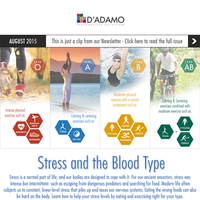
In its most simplified sense, stress is what you feel when the demands on your life exceed your ability to meet those demands. Your blood type is a critical component in the determination of your ability to meet the demands.
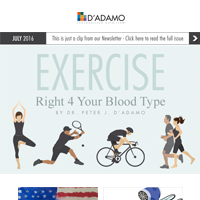
Exercise and Stress
Exercise is a mixed blessing when it comes to stress. A high level of physical fitness will definitely allow the nervous system to recover more rapidly from stress. A moderate amount of physical activity on a consistent basis will also tend to reduce the overall stress response. Because of this, exercise is often described as a panacea when it comes to moderating against stress or helping to de-stress. However, this is not always the case.
Everyone has an envelope of tolerance for exercise. Train within the envelope and exercise is a great method for managing or releasing stress. It acts as a safety valve to let off extra steam. Consistently pushing the limit of this envelope is where the most progress occurs when trying to improve performance. But what happens if you consistently push beyond this envelope, exceeding your tolerance levels and your ability to adapt? The classic manner to describe this is over-training. When you are over trained your performance declines. Does this sound familiar? It should because over training acts just like stress on your internal balance. Let's take a look at two imaginary people and their exercise routine to get a better understanding.
Read more...
|
|
Depression, Stress, and Your Blood Type |
Ginger Nash, ND, MIFHI
|

|
Are individuals of certain blood types more susceptible to different types of depression or anxiety? What causes this?
One's blood type can certainly predispose an individual to different ways of responding to stress and balancing mood. This is because the gene that codes for ABO blood type also affects other genes in close proximity that control things like dopamine metabolism, cortisol levels, and other processes that will affect the entire nervous system's coordination. For example, Type B needs additional nitrogen rich foods and supplements because their bodies lack the ability to produce a compound called nitric oxide to the extent that the other blood types do. Nitric oxide helps coordinate the nervous system, immune system and cardiovascular system. We know that when you are stressed all three of these systems are put under more strain.
Another important factor is the stress hormone cortisol. Type O produces the least amount and Type A produces the most amount of cortisol. When cortisol is continually over-produced it can cause adrenal exhaustion and the corresponding symptoms of depression and fatigue. Type O’s reaction to stress can cause an overproduction of adrenaline which can make them more susceptible to anxiety when stressed. But again, long-term imbalances can create more depression from burn out of the nervous system as well.
What role does everyday stress play in depression?
Certainly Type A, with their naturally higher levels of cortisol, are particularly prone to problems from "everyday" stress. As the adrenal glands pump out more and more cortisol they eventually tire out, causing the person to have a quicker response to minor stressors. Type O’s are more prone to problems that arise from an inability to clear stress hormones from their system quickly; it takes more to get a Type O stressed but it takes more to de-stress them as well. That's why they require more vigorous exercise, whereas Type A can do a lot with yoga and Tai Chi for cortisol balance.
What suggestions do you have for individuals of each blood type to alleviate stress and/or depression?
So as I just mentioned Type A does better with activities that clear cortisol from their systems, like yoga and Tai Chi. Type O does better with more vigorous exercise that clears a class of stress hormones called catecholamines from their bodies. Type B can also benefit from more calming exercises especially if they are prone to depression in the family. AB’s benefit from routine and anything that keeps their immune system functioning properly like eating and going to bed at the same time, routine cleansing, and avoiding extremes in terms of lifestyle.
Are there any foods that may have mood enhancing benefits? What about supplements?
Foods that are rich in essential fatty acids have shown benefit in people struggling
with depression -fatty fish would be a good source of DHA and EPA. Also, many
nuts and seeds that are beneficials in your diet are rich in essential fatty
acids. Things like walnuts, pumpkin seeds, and almonds. Foods rich in Vitamin
B12 and folic acid, in addition to supplementation, are also beneficial. Brewer's
yeast, brown rice, oats and animal proteins that are good for your genotype would
be recommended. Some studies have shown a benefit from regular dark chocolate
consumption on mood. This is probably due to their flavonoid content. Green tea
is also rich in beneficial flavonoids that have benefits for many reasons, but
among them is mood as well. In addition, green tea is rich in a naturally occurring
amino acid, L-Theanine, which has calming effects on the nervous system. So green
tea is good for depression and anxiety, which often go hand in hand.
|
|
Managing Mild Anxiety Attacks |
Ann Quasarano
|
| Guided imagery allows you to use your imagination to go to a safe place and let the anxiety pass. Sit in a quiet place, close your eyes and focus on a place that makes you feel happy and visualize it with all of your senses. |
|
By the time we reach adulthood, we’ve most likely experienced a panic attack or anxiety attack. Lots of things can trigger mild anxiety; public speaking, worries over a test or work project or concern over a friend or family member’s health or well-being. Just like our tolerance for certain foods, our tolerance for stress is different based on our blood type and yet, even among blood types, each individual responds very differently based upon our personal experience.
My good friend, also a blood type A, experiences acute anxiety attacks and has been in the emergency room on more than one occasion, convinced that she was having a heart attack, while my response typically involves obsessive thinking about the subject of my anxiety – frequently at 3 o’clock in the morning. While there is almost no way to completely stop occasional mild anxiety, we are, after all, human, there are ways to reduce the severity of an attack and calm ourselves before old man anxiety gets the better of us.
Breathing – Simple deep breaths can help you to center yourself and calm down.
With your eyes closed, take a deep breath in through your nose and out through
your mouth. Try to fill your lungs and belly when you breathe in and empty them
when you let your breath out. Repeat this at least 10 times. Another helpful
technique involves breath counting. For this exercise, breathe as you normally
would, the first time you exhale, count “one” to yourself, the second time, count “two” to
yourself – continue counting until you get to ten and then repeat the process.
Focusing on the breathing and counting will focus your mind and control anxiety
provoking thoughts.
Meditation - In the past, when I’ve suggested meditation, people have told me
that they “don’t know how to meditate.” In my opinion there is no “right” or “wrong” way
to meditate - I believe there are as many types of meditation as there are people!
So don’t add to your anxiety by being concerned that you are not meditating correctly.
The focus in meditation is to be in the present moment and concentrating on your
breathing. If you can, lay down in a comfortable spot, for the first minute,
focus solely on your breathing – in through your nose, out through your mouth.
Beginning with your feet, focus on each part of your body, slowly moving up from
your feet to the top of your head. As you do this, mentally visualize the body
part and focus on intentionally relaxing that area of the body, “my feet are
relaxed, my muscles are relaxed, I am relaxed. My ankles are relaxed, my muscles
are relaxed, I am relaxed.” Do this all the way to the top of your head – be
warned, you may fall asleep before you get to your knees!
Guided Imagery – This is one of my favorites for preventing anxiety from taking over your thinking and calming your body. Guided imagery allows you to use your imagination to go to a safe place and let the anxiety pass. Sit in a quiet place, close your eyes and focus on a place that makes you feel happy and visualize it with all of your senses. Perhaps you love being on the beach – picture the ocean before you and the waves rolling in and out in sync with the rhythm of your long, deep breaths. Feel the warmth of the sun on your skin, see the sunlight dance and sparkle on the water, smell the salty air, imagine the rough, golden sand beneath you, hear the cry of the gulls as they soar above your head, carrying away all your troubles. Focus on the moment and enjoy being there – it’s almost as refreshing as a vacation!
While these methods may not completely eliminate your anxiety, it may reduce
both the frequency and intensity of the attacks. For those times when you
need a little extra help, Cortiguard for
blood type A and B and Catechol for
blood types O and AB, contain herbs that have a calming effect. Tranquility
Base is also a good tonic (take it before bed to relax). Low levels of Vitamin
D have also been found in people suffering from mild and seasonal depression,
so make sure that your levels are up to par by taking a supplement daily. |
|
Video Clip: A Chat with Chef Kristin O'Connor at NBC CT Studios |

|
On February 15, Kristin
appeared on our local NBC News CT station promoting the Personalized
Living Using the Blood Type Diet® cookbooks. She whips up a
homemade dressing and kale salad with caramelized onions (see the recipe
below!).
|
| Spotlight: Lisa Colasurdo - My
Journey from Beans to Beef |

| Over the next few weeks I experienced physical improvements in digestion and energy levels. As time went on, there were even a few surprises, like improved eyesight, gray hairs returning to brown and stronger finger nails. At 51 years of age, I am clearly in the best health of my entire life, including my sickly childhood.
|
|
Unlike most folks who adopt a diet to lose weight or address a physical concern like heart disease or diabetes, I came to this way of life suffering from brain fog, lethargy, and overall feelings of despair. Once full of energy and vitality, I now spent my days hoping to discover why a physically fit person following an organic, whole foods diet packed with vegetable protein could be so mentally unwell. I had everything to live for and yet my emotional well being was in a continued downward spiral and my ability to think clearly was decreasing.
While there were a few signs that physically my body was not functioning optimally, it was the loss of mental clarity and the inability to experience joyful feelings for any length of time that were my main demons. Hoping someday to find a solution to this “mess in my head,” I continued my routine of exercising and eating a whole foods organic diet. I did anything else I could think of that might help in the process. I meditated daily, eliminated wheat to remove any possibility of celiac disease, eliminated toxins, pleaded with a Higher Power, had a visit with a Naturopathic Doctor and still was experiencing no improvement. At times I had difficulty putting thoughts together. Each year I seemed to be more depleted.
I began the Blood
Type Diet in December of 2008 but before I discovered it, I confided in my mother that I wanted no part of Christmas. I didn’t want a tree, decorations, or to cook a meal. I just wanted it all to go away. I struggled that year to put on my happy face and get a turkey on the table for Thanksgiving.
During this period I was a Personal Chef with a holistic nutritional certification. I held the experience and credentials to guide my clients to improved health while ironically, I couldn’t even help myself. As my energy waned, so did my business.
Having what I would later refer to as the “Hunter Intensity” (from Dr. D’Adamo’s Genotype
Diet), my spirit was never completely broken and I eventually stumbled into the Dallas Wellness Center. When I explained my current diet to Debra Dallas, her first question was “What’s your blood type?” I responded “Type O”, to which she explained I should be eating beef at least 3 times a week. I could not remember the last time I ate a piece of beef. As a child, it was my most hated food and usually ended up half chewed in my napkin.
I now contemplated the unintended assault on my body, and a wave of terror ran
through me like a lightning bolt. A long buried memory surfaced. There I was,
in a bookstore, reading the jacket of Dr. D’Adamo’s, Eat
Right for Your Type, quickly dismissing the idea that a diet high in
protein could ever work for me. I was in a panic at the possibility that I had
been so unknowingly cruel to the body I tried so desperately to balance.
I left Debra’s office that day hopefully confused. It had never occurred to me that my diet could have such tremendous influence on my ability to think and feel positive emotions, particularly since I believed I was eating healthy. I drove directly from her office to a local beef farmer and purchased several cuts of meat, hoping her recommendations were correct. I hurried home and cooked a large steak. Stuffing myself with an oversized T-bone probably wasn’t the best strategy but as I adapted a kinder, gentler way to introduce the meat I had long abandoned, my mood lifted and clear thinking returned. A turning point was when I found myself singing out loud and realized I hadn’t done that for years.
I learned from reading Dr. D’Adamo’s, Live Right for Your Type, that a compound
found in red meat, (L-tyrosine) increases the neurochemical dopamine in type
O’s. As dopamine contributes to feelings of well-being and mood stability, my
emotional slump and depressed feelings had a perfectly logical explanation. The
addition of beef to my diet had nearly immediate positive effects on my emotional
and mental state.
Over the next few weeks I experienced physical improvements in digestion and energy levels. As time went on, there were even a few surprises, like improved eyesight, gray hairs returning to brown and stronger finger nails. At 51 years of age, I am clearly in the best health of my entire life, including my sickly childhood.
My journey did not end with the Blood Type Diet but progressed to the Genotype Diet and Swami. I became consumed and passionate about this new way of living. I was inspired to study all the material I could find, become active on the BTD forums (aka wholefoodie) and attend the 2011
Institute for Human Individuality Conference, earning a fellowship credential.
In an exciting combination of passions, I am currently enjoying educating the public through workshops, and counseling individual clients to optimize their health, all in accordance with their blood type. Life is good!
|
|
Recipes: Dinner Right for Your Type® |
For more recipes, visit the Recipe Center on www.dadamo.com or www.genotypediet.com
|

|
Excerpt from the NEW Personalized Living Using the Blood Type Diet® e-cookbooks! |
|
This delicious dinner is excerpted from Personalized Living
Using the Blood Type Diet® e-cookbooks.
Raw Kale Salad With Zesty Lime Dressing
Salad Ingredients:
- 1 bunch of kale
- 2 teaspoons olive oil
- 1 large white onion, sliced
- ½ cup raisins
Dressing:
- 2 tablespoons olive oil
- 2 limes, juiced
- 1 clove garlic, minced
- ¼ cup chopped walnuts
- 1/8 teaspoon ground cumin
- Sea salt to taste
How to Make it:
- Wash kale and dry on kitchen towels. Strip kale off the woody stems by holding the stem with one hand and wrapping finger and thumb of the other hand around the stem and pulling quickly down. Discard stems and tear leaves into bite-sized pieces. Place in a large bowl and set aside.
- In a skillet over medium heat, add onions and sauté with 2 teaspoons olive oil for 3-4 minutes. Add raisins and continue cooking for 5 minutes. Remove from heat and toss with raw kale.
- In a small bowl, whisk dressing ingredients: 2 tablespoons olive oil, lime juice, garlic, cumin, and salt. Drizzle over kale salad and toss to coat.
Lemon Ginger Salmon
Salad Ingredients:
- 1 lb wild salmon
- 2 teaspoons olive oil
- ½ teaspoon sea salt
- 1 lemon, zest and juice
- 2 tablespoons fresh ginger, grated
- 1 teaspoon honey
How to Make it:
- Pre-heat oven to 400 degrees.
- Rub 1 teaspoon olive oil on salmon and season with sea salt.
- In a small bowl, mix the zest of 1 lemon, 1 tablespoon lemon juice, 1 teaspoon
olive oil, ginger and honey until combined. Brush evenly over the top of
your salmon.
- Bake for 10-12 minutes.
|
|
Personalized Living Using the Blood Type Diet® e-cookbooks
on Amazon Hot List! |

|
The Personalized Living Using the Blood Type Diet® cookbooks
made their debut on Amazon on February 14, and that same week hit the Amazon “Hot
List” at number seven! And
it’s no wonder – people love them!
One reviewer said...
“I am fairly new to the entire concept of eating right
for one's blood type, but I would be skeptical if anyone told me there existed
a more perfect and applicable introduction for me and others like me. This book
starts with basic concepts and education, takes us through how to start/ reset
our palates and pantries, and then (as if all that weren't more than enough)
throws in over a 100 delicious recipes on top of that! I've tried a bunch, and
am looking forward to the rest. Really a thorough and extremely helpful book—one of a collection that I would recommend to anyone interested even in healthful
eating in general.”
The books are a great value at only $9.95 each and can be read on any Kindle
product, web browser, PC, Mac, iPhone, iPad, BlackBerry, or Android phone—and
good news for the technophobes out there—due to overwhelming requests,
we will be publishing soft-cover versions of the cookbooks by early summer 2012!

Visit Kristin’s blog to keep on top of what's happening and to get new
recipe ideas at:
Personalized
Living Using the Blood Type Diet. |
 |
The Blood Type Diet® App available
now for the iPhone, iPad, and Android devices. Just $3.99.
|
 |
Note from a very, happy app user:
This is the most incredible, informative diet app I have ever seen!
I love it! Thanks so much and please keep updating it! An app to help
me better my life is priceless!
Much thanks,
Jonathan Leonard
Sent from my iPhone
|
|
Right For Your Type News |
University of Bridgeport to Open Center For Excellence |

|
The college will soon be able to expand its training and provide more naturopathic
health services to the greater Bridgeport community with the development
of its new Center
for Excellence in Generative Medicine, which is slated to
open in late March or early April. The center will be located in a
grand, white former Victorian across the street from UB's Health
Sciences Center, where many naturopathic students are currently trained.
The
Center for Excellence will build on the work of its new director, Dr. Peter
D'Adamo, supervising physician of the personalized medicine shift at
the Health Sciences Center. D'Adamo is perhaps best known for writing the
best-selling 1996 book "Eat Right 4 Your Type," which advocates
the theory that your blood type is a genetic marker that dictates which
types of foods are best for you.
Read
more...
|
Kate Upton's Trainer Reveals Her SI Swimsuit Cover Fitness Routine |

|
Describing the newest Sports Illustrated Swimsuit cover model as “very spunky, a real go-getter,” Justin Gelband had only the best things to say about Kate Upton when we spoke this afternoon. The 19-year-old is making a splash this week in a barely-there string bikini on her first Swimsuit Issue cover, just a year after earning the Rookie of the Year title from the publication.
The creator of a workout method he calls Model Fit says he customizes every workout and nutrition plan for each client, whether a Victoria’s Secret model, swimsuit model, or the moms he trains in his New York studio.
He told us it’s important to “functionalize your program to work for yourself,” going
back to his advisement to do what’s best for you and not the model on a magazine.
It’s that focus on customized workouts that suit the whole of a person’s
needs (from weight management to their day job as a model or a sitting at
a desk) that makes his “model fit” methods work. Couple that with his use
of the Blood Type Diet and you’ve got some keys to his and his clients’,
success. “[The Blood Type Diet] allows your food to digest better,” said
Justin. “Then the blood generates more cells and energy.” The program, created
by Dr. Peter D’Adamo, identifies the best nutritional plan based on your
unique blood type.
Read
more...
|
Right for Your Type® on Social Media - Follow us! |

|
Get up to the minute health news, Dr. D'Adamo's latest blogs, product specials and more!
Follow
us on Facebook
(direct link - Fans of North American Pharmacal/D'Adamo Personalized
Nutrition)
Follow
us on Twitter
(search - DADAMONUTRITION)
Follow Dr. D'Adamo's Blogs
(n=1) focuses
on personal genomics.
Blood Lines focuses
on blood type science and nutrition.
The Two Cultures focuses
on the schism between the humanities and sciences.
The
SWAMI Blog focuses on SWAMI techniques and tricks.
Grandly But
Moderately is a blog about Brooklyn, New York.
Personalized Living
Using the Blood Type Diet is a blog about healthy eating according
to the Blood Type Diet
|
|
|
|
Just Ask
|
1-877-ABO TYPE
|
|
Dr. D'Adamo's Newsletter
|

Our newsletter is full of helpful information and absolutely free of charge.
Read Previous Newsletters
|
|