
Blood group O individuals have a greater risk of infection with cholera and develop the most severe and life threatening forms of this illness.
If you are blood type O, you may want to postpone that trip to Haiti.
Blood group O individuals have a greater risk of infection with cholera and develop the most severe and life threatening forms of this illness. Type O had more diarrhea-like stools per day than persons of other blood groups, and were more likely to report vomiting and muscle cramps.
At the Matlab Hospital of the International Centre for Diarrhea Disease Research,
Bangladesh, the blood groups of patients hospitalized between January and September
1979 for diarrheal disease due to cholera was examined. A significant association
was identified only for cholera, in which cholera patients were twice as likely
to have blood group O and one-ninth as likely to have blood group AB as community
controls. (3) Cholera infections are particularly severe for blood group O individuals,
who are less protected by the current vaccines. (4)
A follow-up study of family contacts of cholera patients, carried out between September 1980 and July 1982, indicated that blood group did not affect an individual’s risk of having a culture-proven infection with V. cholerae but was directly related to the severity of disease. Individuals with the most severe diarrhea compared with those with asymptomatic infection were more often of blood group O (68% versus 36%, p less than 0.01) and less often of AB (0% versus 7%, p less than 0.01). The constant selective pressure of cholera against people of O blood group may account in part for the extremely low prevalence of O group genes and the high prevalence of B group genes found among the people living in the Gangetic Delta.
A household survey at the onset of the 1991 Latin American cholera epidemic, investigated the surprisingly high attack rates in Trujillo, Peru. It showed an association between blood group O and severe cholera. Of 463 persons in 69 households, 173 (37%) reported diarrhea, 21% required rehydration therapy, and 4% were hospitalized; these treatment requirements greatly exceeded estimates based on other populations. Elevated anti-cholera antibody titers were present in 52% of 321 from whom serum was obtained; 73% were blood group O. Blood group O was strongly associated with severe cholera: Infected persons had more diarrheal stools per day than persons of other blood groups, were more likely to report vomiting and muscle cramps, and were almost eight times more likely to require hospital treatment. Group AB seemed to have the least problematic symptoms.(5)
Since prevalence of blood group O in Latin America may be the world’s highest,
it is thought that this explained the higher mortality observed in the Peruvian
outbreak.
Milligan G, Kostenis E. Heterotrimeric G-proteins: a short history. Br J Pharmacol. 2006 Jan;147 Suppl 1:S46-55.
Sinclair HR, de Slegte J, Gibson GR, Rastall RA. Galactooligosaccharides (GOS) inhibit Vibrio cholerae toxin binding to its GM1 receptor. J Agric Food Chem. 2009 Apr 22;57(8):3113-9.
Glass RI, Holmgren J, Haley CE, Khan MR, Svennerholm AM, Stoll BJ, Belayet
Hossain KM, Black RE, Yunus M, Barua D. Predisposition for cholera of individuals
with O blood group. Possible evolutionary significance. Am J Epidemiol. 1985
Jun;121(6):791-6.
Holmner A, Mackenzie A, Krengel U. Molecular basis of cholera blood-group
dependence and implications for a world characterized by climate change. FEBS
Lett. 2010 Jun 18;584(12):2548-55.
Swerdlow DL, Mintz ED, Rodriguez M, Tejada E, Ocampo C, Espejo L, Barrett
TJ, Petzelt J, Bean NH, Seminario L, et al. Severe life-threatening cholera
associated with blood group O in Peru: implications for the Latin American
epidemic. J Infect Dis. 1994 Aug;170(2):468-72.
New Beginnings
Martha D'Adamo
Taking the time to review the past allows us to envision the future, and we can express our gratitude for what we have and what we have done as well as envision what we would like to welcome into our lives.
I love the passage from one year to another. The change in calendar represents an opportunity for re-evaluation and re-invention and the chance to assess who we are, what works in our lives, and what we may want to change or develop as we enter the new year.
During our editorial meetings in the early fall, Ann Quasarano, the managing editor of the newsletter, and Wendy Simmons-Taylor, the graphic designer, discussed the possibility of exploring a physical redesign of the newsletter to create a new look for 2011. We explored a number of options, and I think we have developed a fresh look and a new format that allows us to continue to provide helpful information that assists you in incorporating the concepts of personalized nutrition in every aspect of your life.
Kudos to Ann and Wendy for all their efforts and for continuing to explore how we can continually improve upon what we are doing!
In many ways, this new look and the process we underwent is symbolic of the transition from one year to the next. At the start of a new year, we have a chance to look back and review our lives – what worked, our successes, our joys, as well as where we could have done something differently, our failures, or perhaps a missed opportunity. Taking the time to review the past allows us to envision the future, and we can express our gratitude for what we have and what we have done as well as envision what we would like to welcome into our lives. This is a wonderful time for goal-setting and dream-weaving. If possible, try to take the time to commit your goals and dreams to paper. Writing them down and referring to them throughout the year keeps you focused on what it is that you want and is an important step in making it happen.
I am so grateful to all of you for sharing the journey of personalized nutrition, for your dedication to health and well-being, and for being part of this revolution in health care. My warmest wishes to you for a new year that brings much joy and happiness, continued good health and vitality, self expression, and the realization of your goals and dreams!
Happy New Year,
Martha
Dr. D'Adamo's Lectures: Blood Type, GenoType®, and the Future of Personalized
Nutrition®
Dr. Peter D’Adamo and Dr. Ginger Nash spoke to a standing-room-only crowd in Hamden, Connecticut in November about blood type, GenoType and the future of personalized nutrition. Listen to the full audio recording of the lecture here:
Hamden Lecture 11-18-10 part 1 (13:28)
Hamden Lecture 11-18-10 part 2 (18:07)
Hamden Lecture 11-18-10 part 3 (15:09)
Hamden Lecture 11-18-10 part 4 (15:04)
Justin Gelband: Exercise Guru to the Stars Supports BTD
Ann Quasarano
“The thing
that I like about this (Eat Right 4 Your Type®) is that there
is no diet, it just says - these are the foods that are good for
you and work with your body. It’s teaching you to eat properly.”
If you’ve ever wondered how celebrities and models get those fabulous bodies,
we’re going to let you in on a little secret…their fitness trainer puts them
on the Blood Type Diet®. Personal trainer and fitness expert Justin Gelband
works with actors like Josh Duhamel, Topher Grace, Anne Hathaway and most of
the Victoria’s Secret catalog and runway models to get their physiques into top
condition. The first step, he says, is changing their eating patterns and getting
them to eat right for their type.
Gelband, a former competitive swimmer, says he discovered the Blood Type Diet® about
7 years ago when a client, a British DJ who is famous on the international nightclub
circuit, told Gelband that his doctor recommended that he go on the Blood Type
Diet®. Gelband decided to give it a try.
“I read the book and started looking at how it works,” Gelband said, “I cut out the avoids, limited the neutrals and loaded up on the beneficial foods. Almost immediately, I had more energy, better digestion, I was leaner and I felt better.”
His own experience prompted him to implement the Blood Type Diet® with “the
girls” as he calls them, the models and actresses that he regularly trains.
“I tell them to find out their blood type and buy the book and everyone loves it. They feel better, their skin looks better, they have better digestion and their metabolism gets quicker. Many of them are type O and can’t have dairy or grains - when they cut those out, they feel better.”
Recently Gelband was interviewed for an article on the website Yahoo.com, where
he mentions that his clients, the Victoria’s Secret models, follow the Blood
Type Diet®. “I got a lot of flack for it on their message board,” he says, “but
I feel like saying to these people, ‘How do you know that it doesn’t work until
you try it?’” Good point!
Gelband says he doesn’t believe in diets – he believes in finding the right foods
that work with your body. “The thing that I like about this (Eat Right 4
Your Type®) is that there is no diet, it just says - these are the foods
that are good for you and work with your body. It’s teaching you to eat properly.”
Learning to eat properly is something that Gelband is passionate about, he says that Americans eat far too much processed food and thinks that restaurant portion sizes are far too large. “How can they expect you to eat properly when they give you such huge portions? How do you rationalize that?”
He says that even the organic restaurant around the corner from his New York City studio is guilty of this. “I asked the chef, ‘Why do you give people such a huge platter of food?’ I don’t want to eat 1,200 calories in one meal. Just eat smaller portions that include a little fat, some protein and good carbs.”
In both exercise and with food, Gelband echos Dr. D’Adamo’s mantra of individuality, “Everyone is different. What’s good for you is not right for the next person.”
Spotlight - Des Depass: Exercise
Right 4 Your Type®
Ann Quasarano
He says that when clients exercise right
for their type, he notices extreme examples of body change – usually
in the direction that they are looking for.
Des Depass is a member of the
New York GenoType group and a personal fitness trainer who
employs the concepts of Eat Right 4 Your Type® and the
GenoType®
Diet with his clients. He says that when clients exercise
right for their type, he notices extreme examples of body change – usually
in the direction that they are looking for.
“Some people say, ‘I want to slim down’ or ‘I want to bulk up’ or whatever they want to do with their body. As long as they follow their diet, they are capable of accomplishing that. It’s perfect! Everyone gets exactly what they are looking for.”
He first learned about the program from his mother, who practices Holistic Detoxification,
Colon Therapy and is also a Massage Therapist. “She had gone to see Dr. D’Adamo
and when she came back, she handed me Eat Right 4 Your Type® and said that
I have to start eating differently,” Des explains, “I am blood type O and had
been eating closer to my mother’s type A vegetarian style.”
Des always thought red meat was unhealthy and would ultimately cause cancer.
Once he started to learn about blood type and digestion, he began to gradually
follow the type O diet. The real turning point came a year and a half ago when
he went to Italy to train an athlete for a fencing tournament.
“She was badly out of shape and needed help. This was when I first tested the
GenoType® Diet. She and I are both Explorers, so we both followed the same
eating program. I cooked all the food and trained her twice a day and by the
end of ten days, everyone was wondering what I had been doing! She looked completely
different in such a short period of time – it defied logic. From that day forward,
I was hooked.”
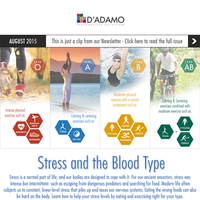
Here are some Blood Type specific workout tips from Des.
Blood Type O – I prescribe heavy lifting and anything where
they can do short bursts of extreme energy. For cardio, lift lighter weights
without letup for a 15 minute burst. I work them as hard as they can and then
break for a few minutes.
Type O sample workout:
For exercise that tones, try circuit training. It's an amazing
form of cardio that combines calesthetics and weight lifting and keeps your heart
pumping hard the whole time. The more exercises you can string together, the
better. Use light to medium weights. Learn to keep
your heart rate up and you will find that you can easily cut down lots of body
fat that will be noticeable right away. Be sure to eat lots of beneficial food
after these workouts or you will find yourself wanting to crash and sleep for
an hour afterwards.
An example of a circuit would be:
Body weight squats (You may add a dumbbell or two or a barbell if you'd like
to make it more difficult.)
Pushups
Bicep curls - 24 reps
Take a 2 minute break then start over.
It is rarely intense enough for blood type O's, but that doesn't mean that you don't need a break from time to time, particularly when it comes to heavy weight lifting. When you want to get more weight up, be sure to stay very hydrated, have many meals throughout the day and when you are lifting, take the extra time for those breaks and you'll find that you are able to get a bit more weight up on that next set.
Blood Type A – The major focus here is STRESS MANAGEMENT. I give blood type A’s the kettle bells, boxing, simulated martial arts and so on. If they are on their own, gardening and carpentry also work miracles. That makes up their cardio and strength training. On lighter days, I keep it mostly to core work and bodyweight movement with some light running involved.
Type A sample workout:
I find that boxing, slow body weight exercises that involve focused breathing (yoga, tai chi, etc.) and kettle bells are some of the best ways to help a blood type A focus while burning lots of calories. It seems that the more you are able to concentrate on the "task at hand" the
easier it is to cope with your stress levels. Boxing, yoga, tai chi, and kettle
bells can have a very large impact on the posture of your body, check with a
personal trainer for using proper form to avoid injury.
Another idea is to do some house work, construction, help someone move or some intense garden work. If you find that your exercises have been exhausting you, perhaps it is time to slow down and quiet your mind.
Blood Type B – This depends on their GenoType quite a bit. If they are a Gatherer, I’ll stick mostly to balance work and keeping them centered and focused. That keeps the pain down and allows them to burn lots and lots of calories. My favorite activity for other B’s is to take them out on a long, slow bike ride for two or three hours – after the ride is over, I swear it looks like they just did full-body liposuction!
Type B sample workout:
20 mile bike ride
Elliptical machines - 45 minutes on a random setting
Standing tricep extensions, bicep curls, shoulder presses on one foot - 25
lb. dumbbells (for men) or 10 lb. dumbbells (for women), keep the repetitions
above 15 times for each arm to tone out. Lift one leg off the ground and continue
doing these exercises.
Stand on the Bosu Ball or some other unstable surface with one leg (weights
not needed, but they do make it more fun).
Keep the balance work as intense as possible. I believe that everyone should do balance work, but it seems to have a much larger effect on blood type B's than the rest of us. Typically a blood type B who is following these exercise suggestions will feel very good and energized after these workouts.
Blood Type AB – I haven’t had as much experience with this blood type. I am still learning about them, after all, they are the rarest blood type! But I’ve found that almost anything but heavy lifting seems to suit them well.
Type AB sample workout:
Combining the mental clarity of a Type A and the Balance of a Type B is the way of the AB.
One day, you might do yoga, the next go for a long bike ride, the following day
practice some Tai Chi, perhaps followed with some light boxing or preferably
martial arts and the next day go into the gym and do standing tricep extensions
with a very slow and controlled pace. The goal is to not make it too intense.
Keep it balanced, moderate and breathe with every movement.
Focused breathing techniques to quiet your mind and focus you before some balance
work is a great way to center yourself and prepare your body for what is to
come. Finish off your exercise with stretching and breathing to calm your body
and relax your mind.
For more recipes, visit the Recipe
Center on www.dadamo.com
As winter’s chill sets in we crave comfort food. Right for All Types,
this Hearty Hash will please the whole family.
Serve with a salad or some roasted veggies for a complete meal.
As winter’s chill sets in we crave comfort food. Right for All Types, this
Hearty Hash will please the whole family. Serve with a salad or some
roasted veggies for a complete meal.
Hearty Hash
Ingredients:
1 cup of uncooked wild rice or quinoa
2 ½ cups of water
1 onion chopped
1 ½ lb. of maitake mushrooms, sliced
1 stalk celery, chopped
1 ½ cup of R4YT broth (vegetable, chicken, turkey)
2 tablespoons of arrowroot powder
2 tablespoons of soy sauce or tamari (optional)
1 tablespoon of parsley flakes
1 tablespoon dried basil
1 teaspoon dried oregano
1 teaspoon dried sage
1 teaspoon dried marjoram
1 teaspoon dried rosemary
1 lb. of ground turkey
How to make it:
Place the rice blend or quinoa in a saucepan with 2 cups
of water and bring to a boil, reduce heat, cover and cook
until done. Set aside and let rice/quinoa rest for
10 minutes.
Meanwhile, place the remaining ½ cup of water in a
large frying pan. Add the onion, mushrooms and celery. Cook,
stirring occasionally, for 5 minutes.
In a bowl, mix the broth, arrowroot powder, soy/tamari (optional),
and herbs. Add to the vegetable mixture while stirring.
Add the ground turkey and cooked rice mixture.
Cook, stirring occasionally, for 5-10 minutes or until
meat is thoroughly cooked.
Right For Your Type® News
New Product: Phyto D 2000™
Phyto D
2000™, formulated by Dr. D'Adamo, includes a unique combination of vitamins D3 and K and is compounded with Epimedium and Drynaria—two traditional Chinese herbs with long historical usage in the support of proper bone and connective tissue health.
Vitamin D has essential, wide-ranging effects throughout the body, including maximizing bone health to stabilizing mood and energy levels.
Increased dietary Vitamin K intake is associated with increased bone formation and decreased bone breakdown.
Phyto D 2000™ also includes Strontium, a naturally-occurring mineral routinely prescribed throughout Europe that has been shown in many studies to reduce the risk of bone fractures.
IfHI 2011 Conference & Certification: Early Registration Continues
Dr. Peter J. D'Adamo and the faculty of The Institute for Human Individuality
(IfHI) will hold the 2011 IfHI Conference & Certification May 20-22
at The Dolce Conference Center located in Norwalk, Connecticut.
For information, call: (203) 761-6701 or email: ifhi@dadamo.com.