
When you arise in the morning, give
thanks for the morning light, for your life and strength. Give
thanks for your food and the joy of living. If you see no reason
for giving thanks, the fault lies in yourself. - Tecumseh
I’ve been immersed in editing a series of lifestyle e-books for each of
the blood types with new recipes, food preparation tips, and meal plans
that we are planning to launch in January. The chef or resident “foodie” as
we refer to her is Kristin O’Connor, who has a passion for food that is
only equaled by her passion and knowledge of personalized nutrition.
Over the past year, Kristin has worked closely with Peter to integrate his concepts
of personalized nutrition and create healthy and delicious recipes for each of
the four blood types.
Last week, as part of the editing process, Kristin prepared a Thanksgiving feast good for all blood types that we are showcasing in this newsletter in time for the holidays. The bonus for me was that she brought samples of each of the recipes that I took home for us to try out, and I have to say, she totally knocked us out. The turkey was cooked to perfection, the kale was sublime, the puree parsnips with garlic were unlike anything I had ever eaten before. Both Peter and I were thrilled with the meal, and we are even more excited about having a series of books specifically for each blood type with secretor/non-secretor substitutions that will serve as a handbook for our customers, readers and friends. Enjoy the recipes, and I would love to hear your comments about them. You’ll be hearing more about the cookbooks in the next newsletter, and we will be launching them after the first of the year.
I tend to become reflective as we get into the fall and the Thanksgiving holiday season, as I become acutely aware of the great bounty that is my life. I am healthy, have a strong marriage/relationship, two wonderful daughters, and an amazing collection of family and friends. I also enjoy freedom of expression in my work and my personal pursuits, the luxury of choice in many things that I do, and opportunities for education, self-development and enrichment that are enhancing and nourishing. I recognize every day that there are others who do not have these same privileges both in the United States and throughout the world, which make these opportunities all the more precious.
Although life has its challenges, it is important to take the time to acknowledge what we have. So often, we focus on being too busy or what we are missing to actually take notice of our good fortune and how it appears in our lives. Although not specifically about Thanksgiving, there is an Indian passage written by Tecumseh, the legendary Native American leader, who advises us to take notice as well as responsibility for that which we are grateful for:
When you arise in the morning,
give thanks for the morning light, for your life and strength.
Give thanks for your food and the joy of living.
If you see no reason for giving thanks, the fault lies in yourself.
We all have something to be thankful for…be happy, be thankful, be appreciative…and
be healthy this Thanksgiving season.
Warmly,
Martha
Audio Clip: Dr. D’Adamo Interviewed on Wide World of Health Radio Show
Peter D'Adamo, ND
Dr. D'Adamo discusses the GenoType Diet.
Cary Nosler gets an education on The GenoType Diet and learns how the foods
you eat affect your health.
(2011 interview; 45:32)
Chef Kristin O’Connor created a Blood Type Diet compliant banquet
that is sure to please everyone at your table.
Cooking for a crowd during the holidays is never easy, but trying to do
it while eating right for your type adds another level of challenge to
the festivities. We’ve decided to make it easy for you with a Thanksgiving
menu that’s right for all types. Chef Kristin O’Connor created
a Blood Type Diet compliant banquet that is sure to please everyone at
your table. Her Thanksgiving menu includes succulent Fig Glazed Turkey
with Apple Butter Gravy, savory Roasted Garlic Parsnip Puree and sweet
Plum Ginger Crumble and other mouthwatering holiday side dishes.
And here’s the best news yet, Kristin and Dr. D’Adamo are just
putting the finishing touches on four new e-cookbooks – one for each
blood type! Each book will feature approximately 150 recipes designed to
be right for you. Now there’s something to be thankful for! The e-books
will be available in January!
Click
here to download a PDF of these delicious recipes!
Fig Glazed Turkey with Apple Butter Gravy Pumpkin Walnut “Cornbread” Stuffing with
Cranberries
Roasted Garlic Parsnip Puree
Glazed Pear and Acorn Squash with Cranberries
Shallot and Bacon Creamed Kale
Plum Ginger Crumble
Ingredient Spotlight: Andrographis
Paniculata
Ann Quasarano
Dr. D’Adamo formulated the aptly named Security supplement with Andrographis and other supportive herbs to enhance immunity and support respiratory health during cold and flu season.
Try saying that 10 times fast! This herbaceous plant may have a tongue-twisting
name, but it’s been used in traditional Siddah and Ayurvedic systems of medicine
as well as tribal medicine in India and other Asian countries to treat everything
from colds to snake bites! Recently, Andrographis has been studied for its
abilities to support upper respiratory tract health and anti-viral properties – and
it has been shown to be particularly effective in treatment and prevention
of the influenza and common cold viruses.
In one study of 540 influenza patients, those receiving Andrographis were shown to have less severe symptoms and a shorter duration of the disease as compared to the control group (approximately 6-7 days, compared to 9-10 in the control group).
Andrographis was shown to have a similar effect on the symptoms of the common cold. In a double-blind randomized study, patients receiving Andrographis reported that symptoms (cough, malaise, nasal discharge, headache, fever, sore throat,) showed significant improvement in symptoms in a decreasing trend starting by day 3 – the placebo group remained either unchanged or worsened. Based on this study, researchers concluded that Andrographis was effective in reducing the symptoms of upper respiratory tract infections.
According to one double-blind, placebo-controlled study, Andrographis may increase
resistance to colds. A total of 107 students, all 18 years old, participated
in a 3-month-long study where the students were evaluated weekly by a clinician
for cold symptoms. By the end of the trial, only 16 people in the group using
Andrographis had experienced colds, compared to 33 of the placebo-group participants.
This difference was statistically significant, indicating that Andrographis reduces
the risk of catching a cold by a factor of two as compared to placebo.
Dr. D’Adamo formulated the aptly named Security supplement
with Andrographis and other supportive herbs to enhance immunity and support
respiratory health during cold and flu season.
Join Eric Morrison’s Battle for Health
Blood Type Diet Film
IfHI Master Eric Morrison has made a short film discussing his experience
with the Blood Type Diet to promote and raise funds for his project,
a full length documentary on The Blood Type Diet. Take a look at his
video and donate
to his cause.
The Flu: Blood Type Differences and the Wonderful Elderberry
Peter J. D'Adamo & Gregory Kelly, ND
In an actual placebo-controlled, double
blind study, an extract
of elderberry fruit has been shown to be effective for treating influenza
B.
Since the publication of Eat Right 4 Your Type, we have found
out a great deal about elderberry fruit. In fact, Peter and I have come
to increasingly rely upon a great-tasting mix of elderberry, blueberry,
and cherry in our clinical practice. While the versatility of elderberry
and these other berries is incredible, this article is going to limit itself
primarily to a focus on elderberry's most well known use—as
a remedy in the common flu.
Many medical experts consider the influenza virus (cause of the flu)
to be the most dangerous virus in the world. Several times in past history,
this virus has been responsible for killing huge numbers of people within
a 1 to 2 year period. As an example, the Spanish flu (type
A(H1N1)) of 1918-19 killed about 500,000 people in the U.S. and at least
20 million people worldwide. In 1957-58, the Asian flu (type
A(H2N2)) resulted in 70,000 deaths in the US and in 1968-69, the Hong-Kong
flu (type (A(H3N2)) killed 34,000 in the U.S.
What is the Flu?
Let's pause here and take a moment to get a clearer picture of what the
flu really is. Terminology and language can be fickle and non-specific
masters, and so the common day-to-day use of the term flu has evolved to
often encompass anything from a common cold to a true flu.
The stomach flu is another misleading term, often used to describe
a gastrointestinal illness (the stomach flu is usually not
even caused by a virus but by other microorganisms). So, the first critical
point to understand is that a flu is not a common cold or a
stomach infection.
When researchers, or doctors speak of the flu, they are being
very specific and mean an infection by the influenza virus. Epidemic influenza
is divided into type A and type B. The most common presentation of influenza
includes a fever (usually 100-103 degrees F in adults), respiratory symptoms
(such as cough, sore throat, runny or stuffy nose), headache, muscle aches,
and often extreme fatigue. So, the second key point is that public health
officials and doctors mean influenza virus when they use the term flu.
The year-in, year-out flu can be deadly (in an average year,
influenza is associated with about 20,000 deaths), especially for the elderly,
immuno-compromised, or those who have an existing condition, such as asthma,
diabetes or heart disease. Even for those of us who are in generally good
health, the flu can still really "take the wind out of
our sails", causing us to feel miserable for several days to a week
or two.
Currently there are three main variants of the flu circulating
(two types "A" and one type "B"). The type A variants
are the "Hong Kong" type A(H3N2) virus and its relatives (responsible
for about 400,000 deaths in the United States since 1968 (90% of which
are among the elderly), and distant relatives of the "Spanish Flu",
type A(H1N1). The "H" and "N" refer to viral proteins
called haemagglutinin (H) and the neuraminidase (N) (more on this in a
bit).
Some medical and public health experts believe it is only a matter of time
(in fact they think we are overdue) before a new pandemic (worldwide epidemic)
of the flu occurs, killing many, many people.
Why has the flu been able to kill such large numbers of people so quickly
in the past?
I am going to oversimplify here, but follow along.
The flu virus is able to mutate or change over time, allowing
it to reinfect you year after year. Usually this is a slow and very gradual
process (both type A and B influenza virus can change in this manner).
As an example, if you were exposed to last year's flu virus,
your immune system would have created a very specific memory of how to
effectively deal with the virus. A new exposure to the same virus would
not now be a problem. Since the virus changes a slight amount each year,
last years immune memory will partially, but not completely protect you
from this year's influenza infection. Think of it in terms of not seeing
a friend for a long while...they will obviously look a bit different, so
it might take a moment for you to recognize them and remember their name.
However, once this moment passes and you remember the name, you now have
a clear idea of how to greet them However, every once in a while, the type
A flu virus (the type B does not change in this manner) will
have a dramatic and abrupt change to either its haemagglutinin (H) and/or
neuraminidase (N) proteins. This results in a new strain of the virus,
which is not recognized as something your immune system dealt with in the
past. It would be as if a new person moved into your town; you have no
information in your memory to identify them as your friend and no idea
of the name. In the years that the flu virus became a worldwide
epidemic and killed into the millions of people, the flu virus
changed in this manner.
Blood type and the flu?
Quite a few different researchers have investigated blood type and influenza.
The volume of research alone is almost enough to suggest strong blood type
connections, but let's look at the research just to be sure.
After exposure to the influenza virus, an immune process termed seroconversion should
occur. This means that your immune system should be producing antibodies
against the influenza virus. Researchers have found that after circulation
of influenza A (type (H1N1) and (H3N2)) and influenza B viruses, the immune
response (as measured in a rise in antihaemagglutinin antibodies against
the virus) differ along blood type lines.
The following generalized immune observations apply:
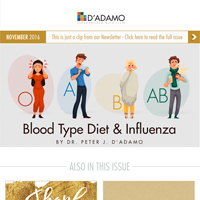
Blood type A: Overall has a great ability to generate a quick and substantial
antibody response against influenza type A(H1N1) and especially A(H3N2).
Their antibody response against influenza B is not quite as dramatic.
Blood type AB: Relatively poor ability to generate high antibody levels
against any of the influenza viruses.
Blood type B: Reasonable, but not great ability to generate an antibody
response against influenza A(H1N1). Slowest (it can take them 3-5 months)
and weakest ability to generate antibodies against influenza A(H3N2) of
any blood type. Against influenza B virus, blood type B has a significant
advantage and responds differently from either blood group A or O. The
blood type B immune response happens much earlier and persists longer.
Blood type O: Relatively decent ability to generate antibody response
against influenza A(H1N1) and A(H3N2) viruses. Antibody response against
influenza B is not as dramatic as blood type B.
Some researchers have hypothesized that one explanation for the typical
emergence of the new epidemic strains of influenza in Asia is connected
to blood type (and the relatively high proportion of type B blood found
in Asia). It seems that blood type B has a genetic predisposition to latent
(chronic) persistence of influenza A virus (especially A(H3N2) "Hong
Kong" variants). Often, the influenza virus antigen can still be found
in healthy type B individuals as much as 5 months after a flu.
This means that although they might not have symptoms, they are providing
a safe harbor for the virus.
With these differences in immune responses, we would expect to see differences
in susceptibility to and severity of influenza infection between the different
blood types...and indeed we do. What we find is that the susceptibility
to influenza changes based upon your blood type and the properties of the
circulating strains of influenza virus.
Looking at influenza A as a whole, the following blood type generalities
exist. People with blood type B are going to be much more susceptible
to infection during times when new antigenic variants and serotype's of
influenza virus appear. This is actually particularly bad news for B's
and AB's, since this is the type of influenza A virus change that results
in widespread flu pandemics. Blood type O individuals tend to be susceptible
to influenza infection at the period of the circulation of virulent strains
(so in years when the flu is making people feel really sick, type O will
be hit the hardest). Type A's are the lucky ones when it comes to influenza
A; they have a generalized susceptibility to the less virulent strains
of influenza A.
Overall, influenza is probably most problematic year to year for Type AB's.
In general, they are more sensitive to infection by both influenza A and
B than the other blood types. They are affected by these viruses earlier
and more severely than those with the other blood groups (and they need
to be extra cautious regarding an abrupt change in the influenza A virus
as well) . Blood type B is most severely affected when the
influenza A(H3N2) (this is the "Hong Kong" variety and its relatives)
is in circulation; has relatively little difficulty with influenza B and
has to be very concerned about an abrupt change in the influenza A strains.
Type O gets less influenza A(H1N1) and more A(H3N2). Type A blood indirectly
offers relative protection against both strains of influenza A.
Will the flu shot protect me?
Does the flu shot protect the blood types differently? Well, what the research
shows is that all blood types will have similar seroconversion frequencies
to both the live attenuated and killed subunit vaccines after the administration
of TWO doses. But after only ONE dose of the live vaccine, blood type A
is much more likely than the other blood types to seroconvert. The lesson
to be learned here is that blood types B, AB and O really should probably
get two doses of the live vaccine for best results (most type A's can probably
get away with just one dose). With the killed subunit vaccine, type O produces
the greatest anti-haemagglutinin antibody response. Again two doses generally
places the blood types on equal ground.
In addition to the blood type information, remember the following. This
year's flu shot is made from the most common flu viruses
in circulation last year. So, in most years, when the virus changes only
a tiny bit from last year, the flu shot will offer some protection.
Note: There are many people nevertheless who benefit significantly from
the flu shot including elderly, chronically ill, and immuno-compromised
individuals. For more information on who should receive this vaccination
it is advised that you contact a physician or the department of public
health.
Essentially, the effectiveness of the flu shot is always going to be dependent
on how closely the vaccine matches the strain of flu virus in current circulation.
So, if the virus changes dramatically from last year (as it did in the
pandemic years), the flu shot will be of little to no use,
because, in essence, it is not providing you with any one who knows this
new person in town. So a key point then with regards to the flu shot
is that it offers protection in most years, but probably not from a pandemic flu.
Antivirals and the flu
Amantadine and rimantadine are chemically related drugs that interfere
with the replication cycle of influenza type A viruses (they are not effective
against influenza type B). They both offer a decent degree of protection
against infection if taken daily during flu season; however,
cost, compliance, and side-effects limit this type of use for most people.
Amantadine and rimantadine are also useful in treatment of the flu;
able to reduce the severity and shorten the duration of influenza A if
given within the first 48 hours. One huge drawback with these antiviral's
is that they result in Amantadine- and rimantadine-resistant influenza
A viruses when they are used for treatment (a very poor long-term strategy
resulting essentially in a possible ineffectiveness of these drugs when
you might need them the most for a severe or life-threatening flu).
Zanamivir and Neuraminidase Inhibitors.
Zanamivir was the first in a new class of drugs known as selective viral
neuraminidase inhibitors. And, if in fact the old saying that "imitation
is the most sincere form of flattery" holds true, this type of drug
must hold tremendous promise. Pharmaceutical and biotechnology companies
(including one of the industry giants—Hoffman La Roche) have quickly
jumped on the neuraminidase band-wagon and are now either planning a launch
or are in the process of developing their own neuraminidase inhibitors.
The reason Zanamivir is such a promising development is that in humans
it not only prevents influenza infection, but also reduces the duration
and intensity of the typical symptoms if given within the first 30 hours
during an influenza infection. Let's take a moment here to discuss haemagglutinins
and neuraminidase in the context of influenza (remember these are the H
and N in the A(H1N1) and A(H3N2) strains).
The influenza virus forms haemagglutinins (essentially protein spikes)
which release an enzyme called neuraminidase in order to spread to new
cells and propagate the infection. From a biochemistry perspective, neuraminidase
is an enzyme that cleaves terminal sialic acid residues from glycoconjugates
(Does the term glycoconjugate remind you of anything? It should, because
the antigens on your cells like your ABO marker are glycoconjugates). By
cleaving off the sialic acid sugar, the virus can escape from infected
cells, spread to new cells, and make the mucus you produce in response
to an infection less effective (yes, the runny nose and mucus you produce
in response to a cold or flu are actually part of your body's defense strategy).
It was assumed that an ability to inhibit neuraminidase would be a useful
medical intervention for treating (and maybe preventing) the flu.
So far in the trials on Zanamivir, this assumption appears to be true.
The biggest disadvantage with Zanamivir is that it is not well absorbed
orally, so must be given by inhalation. Its use might also be limited by
its cost. So far, researchers claim that resistance of the virus to the
drug has been only rarely observed (but remains a possible area of concern).
Elderberry and the flu
So where does elderberry fit in this portrait of the flu. I
have mentioned it was used historically, but does it work? In experiments,
elderberry actually does inhibit replication of all strains of human influenza.
In an actual placebo-controlled, double blind study (the scientific gold-standard
so to speak) an extract of elderberry fruit has been shown to be effective
for treating influenza B. What this research showed was that people using
the elderberry extract got better much quicker (more than 70% were better
after 2 days and over 90% of people completely resolved the infection within
3 days). In contrast, the people given a placebo often needed as much as
6 days to feel well.
Why does elderberry work? Well, the researchers found two reasons really.
People taking the elderberry were able to produce higher anti-haemagglutination
titers to influenza B (meaning their immune system essentially performed
better and they now have a higher level of recognition should this flu return).
And, elderberry inhibits neuraminidase (yes, that is the same neuraminidase
that scientists are spending millions of dollars designing drugs against).
(Editor's note: Zanamivir to an extent duplicates this neuraminidase blocking
ability of elderberry, but does not appear to have elderberry's beneficial
impact on the immune system).
An important question that has not been answered yet is...will elderberry
work as well against influenza A strains? I don't have a definitive answer
for you on this yet, but based upon its method of action, its in vitro
ability, and my clinical observations, the answer is probably yes. Our
patients taking the elderberry, blueberry, cherry and apple concentrate
mixture, seemed to pass easily through this past flu season.
The one word of caution I leave you with is that when it comes to daily
use of elderberry, more is not always better. Large doses will lead to
nausea. If you are trying to avoid a flu a small amount daily
might help. I recommend elderberry especially for type B's and AB's because
of their general susceptibility to the virus. For treatment we use 2 tablespoons
3-4 times daily for adults and less for children depending upon their body
weight.
So, the final key point is...next flu season remember your
friendly elderberry.
Naikhin AN, Katorgina LG, Tsaritsyna IM, et al. Indicators of collective
immunity to influenza depending on the blood group and sex of the population.
Vopr Virusol 1989 Jul-Aug;34(4):419-23 [Article in Russian]
Aho K, Pyhala R, Visakorpi R. ABO associated genetic determinant
in H1N1 influenza. Tissue Antigens 1980 Oct;16(4):310-3
Lebiush M, Rannon L, Kark JD. The relationship between epidemic influenza
(A(H1N1) and ABO blood group. J Hyg (Lond) 1981 Aug;87(1):139-46
Sominina AA, Tsubalova LM, Karpova LS, et al. Genetic predisposition
to latent influenza A virus in children with blood type B(III) as a
possible cause of new epidemiologic strains in the countries of South-Eastern
Asia. Vestn Ross Akad Med Nauk 1994;(9):21-4 [Article in Russian]
Fedorova GI, Slepushkin AN, Popova NS, et al. Correlations of the
antigenic specificity of human blood with the levels of antihemagglutinins
to influenza viruses. Vopr Virusol 1983 Jan-Feb;28(1):54-7 [Article
in Russian]
Mackenzie JS, Fimmel PJ. The effect of ABO blood groups on the incidence
of epidemic influenza and on the response to live attenuated and detergent
split influenza virus vaccines. J Hyg (Lond) 1978 Feb;80(1):21-30
Mackenzie JS, Wetherall JD, Fimmel PJ, et al. Host factors and susceptibility
to influenza A infection: the effect of ABO blood groups and HL-A antigens.
Dev Biol Stand 1977 Jun 1-3;39:355-62
Frolov VK, Sokhin AA, Sotnik AY, et al. Polymorphism of human blood
groups and incidence of influenza A/Hong Kong (H3N2). Acta Virol 1975
Sep;19(5):406-12
Karpova LS, Popova TL, Oleinikova EV, et al. Significance of persons
with different blood groups in the influenza type A epidemic process.
Zh Mikrobiol Epidemiol Immunobiol 1982;(11):86-91 [Article in Russian]
Zakay-Jones Z, Varsano N, Zlotnik M, et al. Inhibition of several
strains of influenza virus in vitro and reduction of symptoms by an
elderberry extract (Sambucus nigra L.) during an outbreak of influenza
B Panama
Right For Your Type® News
University of Bridgeport Establishes Dr. Peter J. D’Adamo
Scholarship for Naturopathic Doctorial Student
Read about the work of Dr. Peter J. D’Adamo and the scholarship that
has been set up at the University of Bridgeport, Bridgeport, CT.
IfHI Master Andrea Cayea invites you to join a Blood Type/GenoType
Support Group in the Williamsburg, Brooklyn, D’Adamo Personalized Nutrition
Center.
The first meeting will be held on Saturday, November 12, from 4:30-5:30 pm.
Join me for the first Eat Right for Your Type Support meeting at the Brooklyn D'Adamo Personalized Nutrition store. We are a group interested in supporting each other toward greater health using individualized nutrition. This month we will focus on getting started and spend some time getting to know each other.
"Nothing is as powerful as an idea whose time has come. Perhaps it is time
for people to open their eyes up to the idea of individualized nutrition; not
just to get rid of a few pounds, but to create health and balance where there
is only sickness and imbalance. The BTD holds so much more promise for the future
of food; under its lens, each food becomes a dynamic entity, which powers that
vary from person to person. So much more interesting that just the protein, fat
and carbohydrate content!" - Dr. Peter D'Adamo
The Run: Moving Natural Medicine Forward to Cross the Finish line in NYC
on 11-11-11
In a historic effort to spark a movement for natural medicine on Main Street, America, Dr. Dennis Godby, ND is running across the USA for the second time—this time with his two sons and nephew. The Run began in San Francisco on July 17, 2011, and will end in New York, NY, on 11-11-11, Veteran’s Day, with a symbolic leg to Bridgeport, CT on November 16, 2011. The coast-to-coast Run is designed to educate and empower Americans about natural health care options: in preventing disease, finding and treating the cause of illness, and revitalizing the nation’s health.
The Run: Moving Natural Medicine Forward, will cross the United States on foot to promote the causes of empowered health care choices throughout America—its mission includes increasing the health of the American people, providing information about sustainable and quality holistic health care options, and educating the public about healthy lifestyle management and health maintenance. The four-month, ninety city journey hopes to introduce the concept of “naturopathic medicine” into the national vocabulary, and make “naturopath” a household term. The Run will also lead to increased health care options for Americans by stimulating interest in naturopathic care, and encouraging more comprehensive insurance coverage for these alternate primary care choices.